

What are the backlash characteristics of a gear - driven actuator?
As an experienced actuator supplier, I have witnessed firsthand the critical role that gear - driven actuators play in various industrial applications. Backlash in gear - driven actuators is a topic of significant importance, as it can have far - reaching implications for the performance, accuracy, and reliability of the overall system.
Backlash, in the context of gear - driven actuators, refers to the amount of clearance or play between the teeth of meshing gears. When the direction of rotation of the input shaft changes, there is a small angular displacement before the output shaft starts to move. This phenomenon is caused by the need to take up the clearance between the gear teeth.
One of the primary characteristics of backlash in gear - driven actuators is its impact on positioning accuracy. In applications where precise positioning is crucial, such as in robotics or CNC machining, even a small amount of backlash can lead to errors in the final position of the actuator. For example, in a robotic arm that needs to pick and place objects with high precision, backlash can cause the arm to overshoot or undershoot the target position. This not only affects the quality of the end - product but can also lead to increased wear and tear on the mechanical components due to repeated corrective movements.
Another important characteristic is the effect of backlash on system dynamics. Backlash can introduce non - linearity into the system, which can make it more difficult to control. When the actuator is operating near the point of backlash reversal, the system may exhibit erratic behavior, such as oscillations or vibrations. These dynamics can be particularly problematic in high - speed applications, where the rapid changes in load and direction can exacerbate the effects of backlash.
The magnitude of backlash in a gear - driven actuator is influenced by several factors. One of the most significant factors is the manufacturing tolerances of the gears. Gears with looser tolerances will generally have more backlash. For instance, if the tooth thickness or the center distance between the gears is not precisely controlled during the manufacturing process, it can result in increased clearance between the teeth. Additionally, wear and tear over time can also increase the amount of backlash. As the gears operate, the teeth can wear down, causing the clearance between them to grow.
Lubrication also plays a role in the backlash characteristics of a gear - driven actuator. Proper lubrication reduces friction between the gear teeth, which can help to minimize the effects of wear and tear. However, if the lubricant is not of the right type or is not applied correctly, it can lead to increased backlash. For example, if the lubricant is too thick, it can cause the gears to bind, while if it is too thin, it may not provide sufficient protection against wear.
In terms of different types of actuators, the backlash characteristics can vary. For a Rotary Electric Actuator, the backlash is often influenced by the design of the gearbox and the motor control system. Electric actuators typically offer higher precision and better control compared to some other types of actuators, but backlash can still be a concern, especially in applications where high - speed and high - accuracy positioning are required.
The Skotch Yoke Actuator has its own unique backlash characteristics. This type of actuator converts linear motion into rotary motion using a scotch yoke mechanism. The backlash in a scotch yoke actuator is often related to the clearances in the mechanical joints and the fit between the yoke and the piston. If these clearances are not properly controlled, it can lead to significant backlash, which can affect the performance of the actuator in applications such as valve control.
The Rack and Pinion Pneumatic Actuator also has distinct backlash characteristics. In a rack and pinion system, the backlash is mainly determined by the clearance between the rack teeth and the pinion teeth. Pneumatic actuators are often used in applications where rapid and powerful actuation is required, but the presence of backlash can limit their accuracy. For example, in a pneumatic valve actuator, backlash can cause the valve to open or close with less precision, which can impact the flow control of the fluid or gas.
To mitigate the effects of backlash in gear - driven actuators, several strategies can be employed. One common approach is to use anti - backlash gears. These gears are designed to minimize the clearance between the teeth by using special tooth profiles or by incorporating pre - loading mechanisms. Another strategy is to implement feedback control systems. By using sensors to measure the position and movement of the actuator, the control system can compensate for the effects of backlash in real - time.
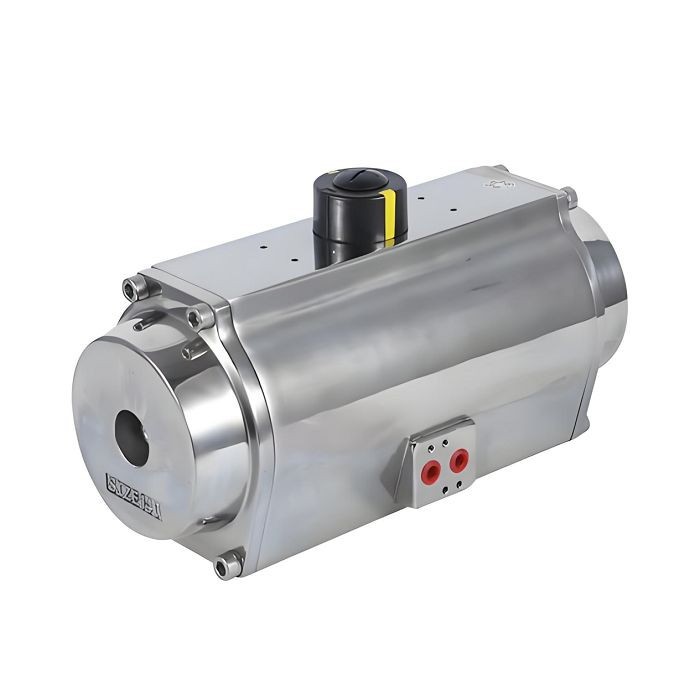

In conclusion, understanding the backlash characteristics of a gear - driven actuator is essential for ensuring optimal performance in industrial applications. As an actuator supplier, we are committed to providing our customers with high - quality actuators that minimize the effects of backlash. Whether you are in the market for a Rotary Electric Actuator, a Skotch Yoke Actuator, or a Rack and Pinion Pneumatic Actuator, we have the expertise and the products to meet your needs. If you are interested in learning more about our actuator solutions or would like to discuss a specific application, we encourage you to reach out to us for a detailed consultation. We look forward to working with you to find the best actuator solution for your requirements.
References
- "Mechanical Engineering Design" by Joseph E. Shigley, Charles R. Mischke, and Richard G. Budynas.
- "Control Systems Engineering" by Norman S. Nise.
- Industry - specific technical manuals and whitepapers on gear - driven actuators.