

In the realm of industrial automation and machinery, Rotary Electric Actuators play a pivotal role. As a supplier of Rotary Electric Actuators, I am often asked about various technical aspects of these devices. One of the most frequently raised questions is, "What is the static stiffness of a Rotary Electric Actuator?" In this blog post, I will delve into this topic in detail, explaining what static stiffness is, why it matters, and how it relates to the performance of Rotary Electric Actuators.
Understanding Static Stiffness
To begin with, let's define static stiffness. Static stiffness is a measure of an actuator's ability to resist deformation under an applied static load. In the context of a Rotary Electric Actuator, it refers to the actuator's resistance to angular displacement when a torque is applied. Mathematically, static stiffness (K) is defined as the ratio of the applied torque (T) to the resulting angular displacement (θ), i.e., K = T/θ.
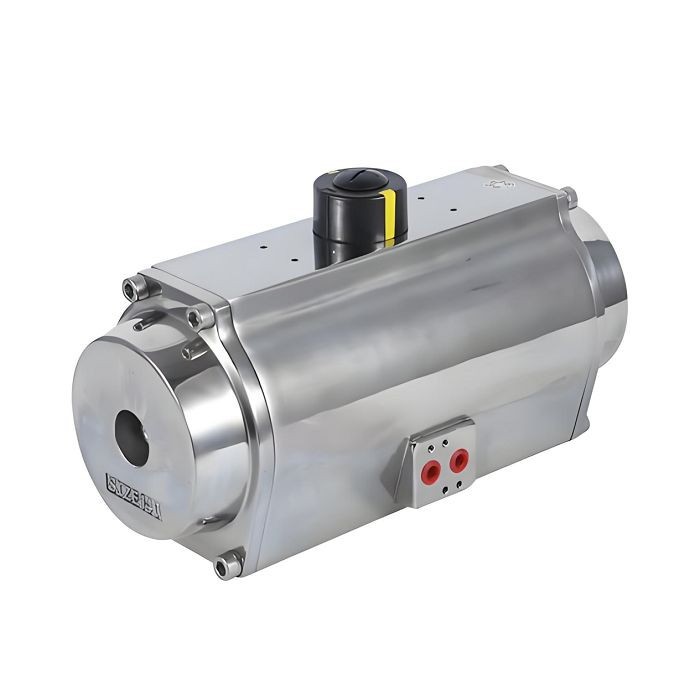

The unit of static stiffness is typically Newton - meters per radian (N·m/rad). A higher static stiffness value indicates that the actuator can withstand a larger torque without significant angular displacement. This property is crucial in applications where precise positioning and stability are required.
Importance of Static Stiffness in Rotary Electric Actuators
Precision Positioning
In many industrial applications, such as robotic arms, CNC machines, and automated assembly lines, precise angular positioning is essential. A Rotary Electric Actuator with high static stiffness can maintain its position accurately even when subjected to external forces or torques. For example, in a robotic arm used for pick - and - place operations, the actuator needs to hold the end - effector at a specific angle with minimal deviation. If the static stiffness is low, the arm may deflect under the weight of the object being picked, leading to inaccurate positioning and potential errors in the assembly process.
Stability
Static stiffness also contributes to the overall stability of the system. When an actuator has high static stiffness, it can dampen vibrations and oscillations caused by sudden changes in load or movement. This is particularly important in high - speed applications where vibrations can lead to premature wear and tear of the components, reduced accuracy, and even system failure. For instance, in a high - speed packaging machine, a Rotary Electric Actuator with low static stiffness may experience excessive vibrations during rapid rotations, which can affect the quality of the packaging and increase the likelihood of machine breakdowns.
Load - Carrying Capacity
The static stiffness of a Rotary Electric Actuator is closely related to its load - carrying capacity. An actuator with high static stiffness can support larger loads without significant deformation. This is beneficial in applications where heavy loads need to be rotated, such as in large - scale industrial conveyors or heavy - duty machinery. A high - stiffness actuator can ensure that the load is moved smoothly and accurately, reducing the risk of overloading and damage to the actuator.
Factors Affecting the Static Stiffness of Rotary Electric Actuators
Gearbox Design
The gearbox is an important component in many Rotary Electric Actuators. The type of gearbox, its gear ratio, and the quality of its components can significantly affect the static stiffness. For example, a planetary gearbox generally offers higher static stiffness compared to a spur gearbox due to its multiple gear meshes and compact design. The gear ratio also plays a role, as a higher gear ratio can increase the effective static stiffness of the actuator. However, it's important to note that increasing the gear ratio may also reduce the actuator's speed and efficiency.
Motor Characteristics
The motor used in the Rotary Electric Actuator also influences its static stiffness. The torque - speed characteristics of the motor, as well as its magnetic properties, can affect how the actuator responds to an applied load. A motor with a high torque - to - inertia ratio can provide better static stiffness, as it can generate a large torque with relatively low inertia. Additionally, the motor's control system can be optimized to improve the actuator's static stiffness by adjusting the current and voltage supplied to the motor based on the load conditions.
Structural Design
The overall structural design of the Rotary Electric Actuator, including the housing, shaft, and bearings, can impact its static stiffness. A rigid housing and a well - supported shaft can help distribute the load evenly and reduce deformation. High - quality bearings with low friction and high radial and axial stiffness can also contribute to the overall static stiffness of the actuator. For example, using angular contact ball bearings instead of deep - groove ball bearings can improve the actuator's ability to withstand axial and radial loads, thereby increasing its static stiffness.
Comparing Rotary Electric Actuators with Other Actuator Types
When considering the static stiffness of Rotary Electric Actuators, it's useful to compare them with other types of actuators, such as Skotch Yoke Actuator and Rack and Pinion Pneumatic Actuator.
Skotch Yoke Actuators
Skotch Yoke Actuators are commonly used in applications where linear motion needs to be converted into rotary motion. While they can provide high torque output, their static stiffness may be relatively lower compared to Rotary Electric Actuators. This is because the skotch yoke mechanism involves sliding components, which can introduce some flexibility and play in the system. In applications where precise angular positioning is critical, Rotary Electric Actuators may be a better choice due to their higher static stiffness.
Rack and Pinion Pneumatic Actuators
Rack and Pinion Pneumatic Actuators use compressed air to generate linear motion, which is then converted into rotary motion through a rack and pinion mechanism. These actuators are known for their fast operation and high force output. However, their static stiffness can be affected by factors such as air compressibility and the mechanical play in the rack and pinion system. Rotary Electric Actuators, on the other hand, offer more consistent static stiffness and better control over positioning, making them more suitable for applications that require high precision.
Measuring the Static Stiffness of Rotary Electric Actuators
There are several methods for measuring the static stiffness of Rotary Electric Actuators. One common approach is to apply a known torque to the actuator and measure the resulting angular displacement. This can be done using a torque sensor and an angular displacement sensor, such as an encoder. The static stiffness is then calculated by dividing the applied torque by the measured angular displacement.
Another method involves using a dynamic test bench, which can simulate different load conditions and measure the actuator's response. This method can provide more comprehensive data on the actuator's static stiffness under various operating conditions, including different speeds and loads.
Conclusion
In conclusion, the static stiffness of a Rotary Electric Actuator is a critical parameter that affects its performance in terms of precision positioning, stability, and load - carrying capacity. As a supplier of Rotary Electric Actuators, we understand the importance of this property and strive to design and manufacture actuators with high static stiffness. By considering factors such as gearbox design, motor characteristics, and structural design, we can ensure that our actuators meet the demanding requirements of various industrial applications.
If you are in the market for Rotary Electric Actuators and need a solution with high static stiffness for your specific application, we would be delighted to discuss your needs. Our team of experts can provide you with detailed technical information and help you select the most suitable actuator for your project. Contact us today to start the procurement discussion and take your industrial automation to the next level.
References
- Johnson, M. (2018). Industrial Actuators: Principles and Applications. New York: Industrial Press.
- Smith, A. (2020). Precision Positioning in Automation. London: Automation Publishing.
- Brown, R. (2019). Actuator Design and Optimization. Berlin: Engineering Books.